Sunglasses Fit: Lens Width, Bridge and Temple in Millimetres
The three numbers inside a sunglasses arm are lens width, bridge width and temple length. How to read them and measure your own face before you buy.
Reviewed by Maya Ellis · Updated Sep 6, 2026
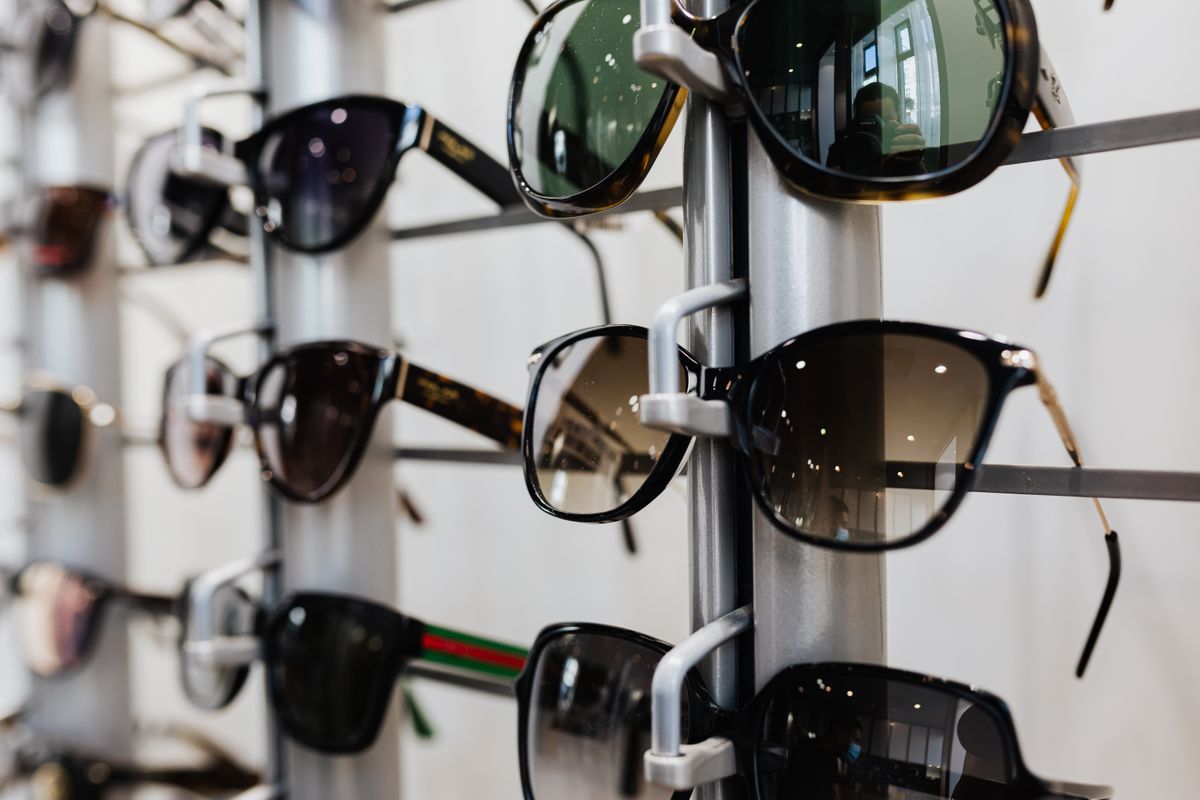
The three small numbers printed inside a sunglasses arm are the only reliable way to compare frames you cannot try on. Read left to right they are lens width, bridge width and temple length, so 52-18-140 means a 52 mm lens, an 18 mm nose gap and 140 mm arms.
Reading the code inside the arm
Look on the inside of one temple arm. The three figures usually sit beside a model code and a colour code, separated by dashes or a small square. Adult frames typically run about 48 to 62 mm for lens width, 14 to 24 mm for bridge and 120 to 150 mm for temple length.
A pair you already own is the best reference: match its three numbers.
Measure your face before the frame
Face a mirror and measure straight across from one temple to the other, just above the ears. That figure is close to your ideal total frame width. Up to about 130 mm suits narrower faces and usually pairs with 47 to 50 mm lenses; 131 to 138 mm is where most adults land, with 51 to 54 mm lenses; 139 mm and above suits wider faces, with 55 to 60 mm lenses. A payment card is 85.6 mm wide if you need a scale; hat sizing uses the same tape around the head.
Why lens width alone misleads
Bridge width decides where the frame sits on the nose, and it is the number people skip. The right lens width with too wide a bridge slides down; too narrow a bridge pinches and leaves marks. Temple length decides whether the arms reach the ear without pressing, and the bend should start roughly where the ear starts. Change the bridge before shrinking the frame — the split watch case sizes describes.
UV400 is not polarisation
UV400 means the lens blocks wavelengths up to 400 nanometres, covering both UVA and UVB; a label reading 100% UVA and UVB protection means the same. Lens darkness has nothing to do with it, and a dark tint without UV filtering is worse than bare eyes: the pupil dilates behind it.
Polarisation is a separate filter that cuts glare from water, roads and snow. It is not UV protection, and the two are checked separately.
What frame materials change
Acetate is the classic plastic, roughly 20 to 30 g a frame and heat-adjustable. Titanium is the lightest metal at about 8 to 18 g, corrosion-resistant but stiffer to adjust. TR90 is an injection-moulded nylon around 9 to 14 g, flexible and impact-resistant, and cannot be heat-adjusted. Stainless steel runs about 15 to 30 g: rigid, good at holding an adjustment, and usually contains nickel.
Three frames show the range:
- Ray-Ban Original Wayfarer RB2140
- Oakley Holbrook OO9102
- Maui Jim Peahi
The Wayfarer is narrow with the widest bridge, the Holbrook opens the wide band at 55 mm, and the Peahi is widest.
Recommendations
Some links below are affiliate links — we may earn a commission at no extra cost to you.
Pick 01
Ray-Ban Original Wayfarer RB2140
Best for a narrow face in glass USD 153
The 50 mm Original Wayfarer is the reference point for a narrow frame, with a 22 mm bridge that sits best on a wider or higher nose bridge. Acetate front, glass G-15 lens and 100% UVA/UVB protection listed on Ray-Ban's own product page. Its 150 mm temples are the longest of the three.
Works
- 50 mm lens width keeps the frame inside a narrow face
- 22 mm bridge suits a wider or higher nose bridge
- Glass G-15 lens, with 100% UVA/UVB protection stated by Ray-Ban
Trade-offs
- Glass is heavier than a polycarbonate lens and can shatter on impact
- The 22 mm bridge and 150 mm temples are a poor match for a small, low nose bridge
Pick 02
Oakley Holbrook OO9102
Best for a wider face USD 174
The Holbrook sits at the low end of the widths that suit a wide face, and its 18 mm bridge holds the frame without the nose gap opening up. Macy's lists the frame as 55/18/137 with a mirrored polycarbonate lens, and Oakley's own product page describes it as lightweight O Matter.
Works
- 55 mm lens and an 18 mm bridge cover a wide face without pinching at the temples
- O Matter nylon frame flexes on impact rather than cracking
- Polycarbonate lens is lighter than the glass in the Wayfarer
Trade-offs
- The 18 mm bridge pinches on a high or wide nose bridge where the Wayfarer's 22 mm sits comfortably
- The frame is built in more than one lens width, so the printed code decides which one you get
Pick 03
Maui Jim Peahi
Best for water and snow glare USD 289
The Peahi is a 65 mm wrap built around glare rather than around the middle of the size range. Maui Jim pairs SuperThin Glass with PolarizedPlus2 lenses, which the brand describes as polarised with full UV blocking. Grilamid frame, silicone nose pads and a spring hinge, and the highest price here.
Works
- 65 mm lens and a wrap shape cut light arriving from the sides
- PolarizedPlus2 lens, described by Maui Jim as blocking UV as well as glare
- Grilamid frame with embedded silicone nose pads and rubber temple ends
Trade-offs
- The wrap shape reads sporty rather than neutral
- Most expensive of the three at USD 289
Comparison
| Spec | Ray-Ban Original Wayfarer RB2140 | Oakley Holbrook OO9102 | Maui Jim Peahi |
|---|---|---|---|
| Lens width | 50 mm | 55 mm | 65 mm |
| Bridge | 22 mm | 18 mm | 19 mm |
| Temple length | 150 mm | 137 mm | 120 mm |
| Frame material | Acetate | O Matter | Grilamid |
| Lens protection | Glass G-15, 100% UVA/UVB | Polycarbonate, mirrored | SuperThin Glass, PolarizedPlus2 |
| Price | USD 153 | USD 174 | USD 289 |
FAQ
- What do the three numbers on sunglasses mean?
- They are lens width, bridge width and temple length in millimetres, printed inside one arm. A code of 52-18-140 means a 52 mm lens, an 18 mm nose gap and 140 mm arms.
- Is UV400 the same as polarised?
- No. UV400 describes blocking ultraviolet light up to 400 nanometres, while polarisation filters reflected glare. Many polarised lenses also block UV, but they are separate claims.
- Which measurement matters most for sunglasses fit?
- The bridge width decides where the frame sits on your nose, so it is the first number to change if a pair slides, pinches or leaves marks.
Sources
- Ray-Ban official product page, Original Wayfarer Classic RB2140 50-22
- Maui Jim official product page, Peahi H202-10
- Macy's product page, Oakley Holbrook OO9102, eye/bridge/temple 55/18/137
- Oakley official product page, Holbrook O Matter frame material
- ScienceInsights, what UV400 means and why polarisation is a separate claim
Maya Ellis
Writes about garment construction, leather goods and footwear specs. Started in retail floor management before moving to editorial research. How we research.